


Online Quran Courses for Kids in the USA: A Parent’s Complete Guide
Top Online Quran Courses for Kids in the USA Muslim parents in the United States often want their children to develop a strong connection with the Quran while managing school, homework, family responsibilities, and busy daily schedules. Online learning can make Quran education more accessible by allowing children to study from home at a convenient time. However, choosing the right program requires careful consideration of the teacher, curriculum, teaching method, schedule, and learning goals.
This guide explores the Top Online Quran Courses for Kids in the USA and explains what parents should look for when choosing an online Quran academy. From Quran reading and Tajweed to Qaida, Hifz, and Islamic studies, the right course should match a child’s age, current ability, and learning needs.
Why Online Quran Courses Are a Good Choice for Kids in the USA
Top Online Quran Courses for Kids in the USA For many American Muslim families, attending a local Quran school every day may not always fit into the family schedule. Online Quran classes provide another option by bringing the lesson directly into the home.
One of the biggest advantages is flexibility. Parents can often arrange classes around school hours, extracurricular activities, weekends, and family commitments.
Other potential benefits include:
- Learning from the comfort of home
- Flexible scheduling
- Individual attention from a teacher
- Convenient access to Quran education
- Personalized lessons based on the child’s level
- Regular Quran practice
- Easier communication between parents and teachers
- No daily travel to a physical classroom
For younger children, studying in a familiar environment can also make lessons more comfortable. Parents can create a dedicated learning space where the child attends class without unnecessary distractions.
The quality of an online course still depends on the teacher and teaching system. Online learning should therefore be viewed as a method of delivery, not automatically as a guarantee of quality.
What Should the Top Online Quran Courses for Kids in the USA Include?
The Top Online Quran Courses for Kids in the USA should provide more than simply asking children to read pages of the Quran during an online call. A well-structured program should consider the child’s current level and gradually build reading, pronunciation, understanding, and consistency.
A comprehensive children’s Quran program may include several areas.
Quran Reading Course
A Quran reading course is suitable for children who need to develop or improve their ability to read Arabic from the Quran.
Beginners may first need to learn Arabic letters, joining letters, vowel signs, and basic reading patterns. As their skills improve, they can progress toward reading complete Quranic verses.
The teacher should correct mistakes patiently and encourage the child to practice regularly.
Online Quran with Tajweed Course
Tajweed helps students learn how to pronounce Quranic letters correctly and apply the established rules of Quran recitation.
A children’s Tajweed course may gradually introduce concepts such as:
- Makharij, or articulation points
- Characteristics of Arabic letters
- Rules of Noon Sakinah and Tanween
- Rules of Meem Sakinah
- Madd
- Qalqalah
- Proper stopping and starting
- Common recitation mistakes
Children do not necessarily need to learn every advanced Tajweed rule immediately. A good teacher can introduce concepts according to the student’s age and ability.
Madani Qaida or Noorani Qaida Course
Beginners often benefit from learning a Qaida before moving into fluent Quran reading.
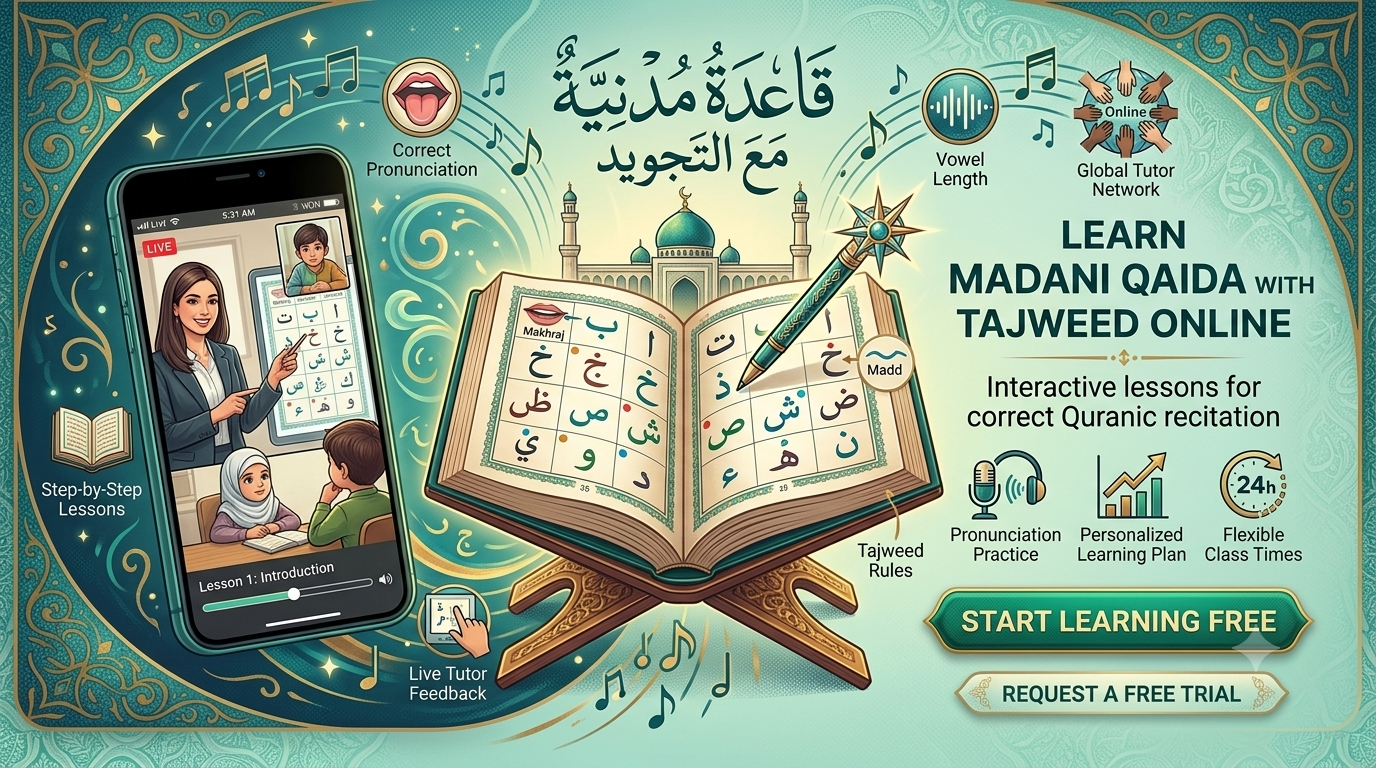
A Madani Qaida or Noorani Qaida course can help children understand Arabic letters, sounds, vowel signs, joining patterns, and basic Quran reading principles.
This foundation can make the transition to reading the Quran more structured.
Parents looking for Madani Qaida online or Noorani Qaida online should check whether the teacher provides systematic practice rather than simply moving through pages quickly.
Online Hifz Quran Course for Kids
Some children and families choose Quran memorization as a long-term goal.
An online Hifz program should place importance on both new memorization and revision. Memorizing new verses without regular revision can make it difficult for a student to retain previously learned portions.
A balanced approach may include:
- New daily lesson
- Previous lesson revision
- Older memorized portions
- Regular assessment
- Consistent practice
- Parent-teacher communication
Children differ significantly in their memorization ability, so the pace should be realistic rather than based on pressure.
Islamic Studies for Kids
Some families also want their children to learn basic Islamic knowledge alongside Quran reading.
Age-appropriate Islamic studies may include:
- Basic Islamic beliefs
- Daily duas
- Islamic manners
- Seerah of Prophet Muhammad ﷺ
- Basic acts of worship
- Good character
- Respect for parents and others
- Everyday Islamic etiquette
The content should be presented according to the child’s age and understanding.
How to Choose the Best Online Quran Course for Your Child
Parents should not choose an online Quran academy only because its website looks attractive or because its price is low.
Before enrolling, consider the following factors.
1. Teacher Qualifications and Quran Knowledge
Ask about the teacher’s Quran and Tajweed knowledge and teaching background. A teacher should understand correct pronunciation and be capable of explaining concepts clearly to children.
2. Experience Teaching Children
Teaching adults and teaching young children require different approaches.
A good Quran teacher for kids should ideally be patient, encouraging, and able to adjust the lesson according to the child’s attention span and ability.
3. Trial or Assessment Class
If a trial class or assessment is available, use it to evaluate the teaching experience.
Observe:
- Does the teacher communicate clearly?
- Does the child feel comfortable?
- Does the teacher correct mistakes respectfully?
- Is the lesson organized?
- Does the teacher understand the child’s current level?
4. One-to-One or Group Classes
Consider whether your child learns better individually or in a group.
One-to-one lessons can provide more direct teacher attention, while group lessons can provide social interaction and may suit children who enjoy collaborative learning.
5. Class Duration
Younger children may benefit from shorter, focused sessions rather than unnecessarily long lessons.
The appropriate duration depends on age, ability, course type, and the child’s concentration level.
6. Schedule Flexibility
American families may have different school, work, and extracurricular schedules.
A useful online program should make it reasonably easy for parents to maintain a consistent learning routine.
7. Parent Communication
Parents should know how they can communicate with the teacher or academy about their child’s progress.
Regular communication can help identify areas where additional practice is needed.
8. Progress Tracking
Ask whether the academy monitors:
- Reading development
- Tajweed progress
- Memorization
- Homework
- Attendance
- Areas requiring improvement
9. Curriculum
Look for a structured curriculum rather than completely random lessons.
A clear learning path helps parents understand what their child is expected to learn next.
10. Online Safety
Parents should also consider the general online learning environment, including appropriate communication, privacy, parental involvement, and the platform used for lessons.
11. Reviews and Testimonials
Reviews can provide useful information, but parents should evaluate them critically. Look for consistent feedback rather than relying on a single testimonial.
12. Pricing and Affordability
Cost is an important consideration, but the cheapest program is not necessarily the best choice.
Parents should compare the complete offering, including lesson duration, frequency, teacher attention, curriculum, and communication.
One-to-One vs Group Quran Classes for Kids
Both learning formats can work well depending on the child.
| Feature | One-to-One Classes | Group Classes |
|---|---|---|
| Teacher attention | High | Shared |
| Personalized pace | Excellent | Moderate |
| Individual correction | Easier | Limited |
| Social interaction | Lower | Higher |
| Flexibility | Often higher | Depends on schedule |
| Suitable for struggling learners | Often helpful | May be challenging |
| Suitable for social learners | Can work well | Often beneficial |
One-to-one classes may be particularly useful when a child needs personalized attention or has specific pronunciation or reading difficulties.
Group classes can work well for children who enjoy learning alongside other students.
There is no universal answer. Parents should consider their child’s personality, learning style, age, and educational needs.
How Online Quran Classes Work for Children in the USA
Parents who have never used an online Quran academy may wonder what the process looks like.
Although every academy may operate differently, a typical process can involve the following steps.
Step 1: Registration
Parents provide basic information about the child and their Quran learning level.
Step 2: Trial or Assessment
If offered, the child may attend an introductory lesson or assessment. This helps the teacher understand the student’s current reading ability.
Step 3: Teacher Assignment
The academy may assign a teacher according to the child’s course and learning level.
Step 4: Schedule Selection
Parents and the academy agree on suitable class times.
Step 5: Live Online Lesson
The child attends the lesson through an online communication platform.
Step 6: Practice and Homework
The teacher may assign Quran reading, memorization, or revision for practice between lessons.
Step 7: Progress Monitoring
The teacher evaluates the child’s progress and identifies areas that need more attention.
Consistency is one of the most important factors. A child who attends irregularly may find it harder to build momentum.
Why Parents Should Choose Qualified Quran Teachers
The teacher is one of the most important parts of any Quran learning program.
A knowledgeable teacher can identify pronunciation problems that parents may not notice.
Important qualities to look for include:
- Strong Quran reading skills
- Knowledge of Tajweed
- Correct pronunciation
- Experience teaching children
- Patience
- Clear communication
- Ability to explain difficult concepts simply
- Understanding of different learning levels
- Positive and respectful teaching style
Parents should also ask questions about the teacher rather than assuming every online Quran tutor has the same qualifications or experience.
Benefits of Learning Quran Online for American Muslim Families
Muslim families across the United States have different routines and circumstances.
A family in New York may have a very different schedule from a family in Texas or California. Children may attend public schools, private schools, Islamic schools, or homeschool programs.
Online Quran learning can provide flexibility for families living in:
- New York
- New Jersey
- California
- Texas
- Florida
- Illinois
- Washington
- Michigan
- Virginia
- Other states across the USA
For families spread across different time zones, scheduling is especially important. Parents should choose class times that children can consistently maintain without sacrificing school responsibilities or adequate rest.
Online learning can also reduce travel time, allowing families to use that time for Quran practice, family activities, or other responsibilities.
Tips for Helping Your Child Succeed in Online Quran Classes
The teacher is important, but parents also play a major role in a child’s learning experience.
Create a Quiet Learning Space
Set up a place where the child can attend class without television, games, or unnecessary interruptions.
Maintain a Consistent Schedule
Children usually benefit from routine. Try to keep Quran lessons at consistent times when possible.
Encourage Daily Revision
Even a short amount of regular practice can help reinforce what the child learned during class.
Reduce Distractions
Before class begins, close unnecessary applications and remove toys or devices that may distract the child.
Stay Involved
Parents do not need to sit beside the child during every lesson, but they should remain aware of attendance, homework, and progress.
Communicate With the Teacher
If the child is struggling with a particular topic, discuss it with the teacher.
Celebrate Progress
Positive encouragement can help children develop a healthy relationship with Quran learning.
Avoid Excessive Pressure
Every child learns at a different pace. Consistent encouragement is generally more productive than comparing one child with another.
Why Choose Qtstutor.com for Online Quran Classes?
Qtstutor.com provides online Quran education for families looking for convenient Quran learning from home.
The academy offers learning options that can include:
- Online Quran classes for kids and adults
- Quran reading
- Tajweed
- Hifz
- Qaida
- Online Quran learning
- Personalized attention
For parents, the most important step is to choose a course that matches the child’s current ability and learning goals.
If you are considering online Quran classes for your child, explore the available courses at Qtstutor.com and learn more about the teaching options available for your family.
How Much Time Should Children Spend Learning Quran?
There is no single schedule that works for every child.
A suitable routine depends on:
- Age
- Current Quran level
- School workload
- Course type
- Memorization goals
- Attention span
- Family schedule
For beginners, consistency is often more important than trying to complete a large amount of material in every lesson.
Parents should focus on creating a sustainable routine that the child can maintain.
How Parents Can Evaluate Their Child’s Quran Progress
Parents can monitor progress by looking beyond the number of pages completed.
Useful indicators include:
- Improved pronunciation
- Greater reading confidence
- Better Tajweed application
- Increased fluency
- Improved memorization retention
- Ability to correct previous mistakes
- Consistent attendance
- Positive attitude toward learning
A child may progress quickly in one area and more slowly in another. The goal should be steady improvement rather than unnecessary competition.
Frequently Asked Questions
What are the top online Quran courses for kids in the USA?
The best course depends on the child’s needs. Common options include Quran reading, Qaida, Tajweed, Hifz, and age-appropriate Islamic studies. Parents should compare teacher expertise, curriculum, schedule, class format, progress tracking, and overall learning environment.
What age should a child start learning Quran?
There is no single required starting age for every child. Many families introduce children to basic Quran learning when they are developmentally ready to recognize letters, listen, repeat sounds, and participate in short lessons. The approach should be age-appropriate.
Are online Quran classes suitable for young children?
Yes, online Quran classes can be suitable for children when lessons are structured around their age and attention span. A patient teacher, suitable class length, quiet learning environment, and parental support can make online learning more effective.
How long should a child’s Quran class be?
Class duration depends on the child’s age, ability, and course. Younger children may benefit from shorter focused lessons, while older students may be able to handle longer sessions. Consistency and engagement are more important than simply making lessons longer.
Can my child learn Quran with Tajweed online?
Yes. Online Tajweed classes can teach students correct pronunciation, articulation points, recitation rules, and common mistakes. The teacher should listen carefully to the student’s recitation and provide individual corrections.
Is one-to-one Quran teaching better for kids?
One-to-one teaching can be beneficial when a child needs personalized attention or has specific learning needs. Group classes can also be effective for children who enjoy learning with other students. The better option depends on the individual child.
How can I find a qualified online Quran teacher?
Ask about the teacher’s Quran knowledge, Tajweed expertise, teaching experience, approach to children, and ability to explain concepts clearly. If available, a trial or assessment class can help parents evaluate the teaching experience.
How much do online Quran classes for kids cost?
Pricing varies between academies and depends on factors such as class frequency, duration, individual or group teaching, and course type. Parents should compare the complete service rather than choosing solely on price.
Can children learn Quran online after school?
Yes. Many families schedule Quran lessons after school or during other suitable periods. Parents should select a time when the child is alert and able to concentrate rather than scheduling lessons when the child is already exhausted.
How can parents track their child’s Quran progress?
Parents can monitor attendance, reading improvement, Tajweed development, memorization, homework, and teacher feedback. Regular communication with the teacher can help parents understand both progress and areas that need additional practice.
Final Thoughts
Choosing among the Top Online Quran Courses for Kids in the USA should not be based on a single factor such as price or convenience. The most suitable program should provide an appropriate curriculum, knowledgeable teaching, consistent practice, and a positive learning environment.
Whether your child is beginning with Qaida, improving Quran reading, learning Tajweed, memorizing the Quran, or studying basic Islamic knowledge, the right approach should be based on the child’s individual needs.
For Muslim parents in the USA, online Quran education can provide a practical way to maintain regular Quran learning alongside school and family life.
If you are looking for an online Quran learning option for your child, visit Qtstutor.com to explore available courses and find an approach that fits your family’s needs.