


Quran for All: Learn, Read, and Understand the Quran Online
Learning the Quran is a meaningful journey that can begin at any age. Whether you are a beginner trying to recognize Arabic letters, a parent looking for Quran classes for children, or an adult who wants to improve recitation and understanding, online learning can make Quran education more accessible.
Today, students can study from home with an online Quran teacher, attend live lessons, practice pronunciation, and gradually build confidence in reading. With the right approach, technology can connect learners with structured Quran education regardless of where they live.
The goal of Quran for All is simple: make learning, reading, and understanding the Quran accessible to Muslims around the world through flexible and supportive education.
What Does “Quran for All” Mean?
The idea behind Quran for All is that Quran education should be approachable for people at different stages of life and learning.
A young student may begin with Arabic letters and Madani Qaida, while an adult learner may already know how to read but want to improve Tajweed. Someone who has recently embraced Islam may need a beginner-friendly introduction, while an experienced reader may want to focus on fluency, pronunciation, or memorization.
This inclusive approach recognizes that every learner has different needs. Some students need more repetition, others prefer structured lessons, and some benefit from one-to-one teaching.
Online Quran education can support these different learning styles by allowing students to study at a suitable pace with lessons designed around their individual needs.
Why Learn the Quran Online?
Online Quran classes have made Islamic education more convenient for families and individuals who have busy schedules or limited access to local teachers.
Flexible Class Timings
Students can often arrange lessons around school, work, family responsibilities, and other commitments. This flexibility is especially useful for Muslims living in Western countries or different time zones.
Learning From Home
There is no need to travel to a learning center. Students can join lessons from a quiet place at home using a computer, tablet, or smartphone.
One-to-One Attention
Individual instruction allows a teacher to identify specific pronunciation mistakes and provide immediate correction. This can be especially helpful when learning Arabic letters, Quranic pronunciation, or Tajweed rules.
Personalized Learning
Not every student learns at the same speed. An experienced teacher can adjust lesson pace, revision, exercises, and homework according to the student’s level.
Improve Quran Recitation
Regular guidance can help students become more accurate and confident in their reading. Consistent correction is particularly valuable when working on difficult Arabic sounds.
Worldwide Accessibility
Online education allows students in the USA, UK, Canada, Australia, Europe, and other regions to connect with teachers without depending entirely on local availability.
How to Learn the Quran Online Step by Step
A structured learning path makes progress easier to measure. Beginners can use the following approach.
1. Learn Arabic Letters and Qaida
Start with the Arabic alphabet, letter shapes, joining rules, vowel marks, and basic reading patterns. A Qaida course can provide a useful foundation before moving into full Quranic passages.
2. Improve Pronunciation
Correct pronunciation matters because Arabic letters can have distinct sounds. Students should practice regularly and accept correction from a teacher rather than relying only on self-study.
3. Learn Tajweed Rules
Once the basics are clear, students can study rules related to pronunciation, elongation, stopping, merging, and other aspects of recitation.
4. Practice Quran Reading
Reading a small amount every day can help build fluency. The focus should be on accuracy first, followed by smoother and more confident recitation.
5. Study Translation and Meanings
Recitation is an essential part of learning, but understanding the message can make study more meaningful. Learners can read a reliable translation and gradually explore explanations of verses.
6. Develop Consistency
Progress usually comes from regular practice rather than occasional long sessions. A realistic weekly schedule can help students remain committed.
Learn Quran with Tajweed Online
Tajweed refers to the principles used to recite the Quran correctly. It helps learners pronounce Arabic letters accurately and observe important rules of Quranic recitation.
A Quran with Tajweed course can be beneficial for beginners as well as students who already read but want to improve their accuracy.
During online lessons, a teacher may listen carefully to each passage, identify pronunciation issues, explain the relevant rule, and have the student repeat the section.
For many learners, the combination of live instruction and regular practice is more effective than simply watching recorded lessons.
Quran Learning for Kids and Adults
Online education can be adapted for different age groups. The teaching approach should match the learner’s ability, concentration, previous knowledge, and goals.
Quran Classes for Kids
Children often benefit from short, interactive lessons with repetition and clear goals. Beginners may start with Arabic letters and basic Qaida before moving to Quran reading and Tajweed.
Parents can support progress by creating a consistent study routine at home. Encouragement is generally more helpful than making lessons feel like a punishment or burden.
A child may also benefit from regular revision, simple homework, and celebrating small improvements.
Quran Classes for Adults
Adults may have very different needs. Some already read the Quran but want to correct pronunciation. Others may be starting from the alphabet after years of not studying.
Online Quran Classes for Adults can be scheduled around work and family responsibilities. Adult learners may also prefer lessons that combine recitation with translation, vocabulary, or basic Quranic Arabic.
There is no specific age at which someone becomes “too old” to begin learning. The best time to improve is simply when you are ready to start.
How to Read and Understand the Quran
Learning to recite is an important foundation, but many students also want to understand the message of what they read.
A balanced approach can include:
Correct Recitation: Build accurate reading skills gradually.
Tajweed: Study the rules that improve pronunciation and recitation.
Translation: Use a reliable translation to understand the general meaning.
Basic Tafsir: Explore explanations of verses in an appropriate educational context.
Reflection: Think about the lessons, values, and guidance presented in the text.
Practical Application: Consider how Quranic teachings can influence personal character, family life, responsibilities, and daily decisions.
Students should remember that translations help communicate meaning across languages, while deeper interpretation may require guidance from recognized scholarly sources.
Benefits of Understanding the Quran
Understanding the Quran can make learning more purposeful. Instead of seeing recitation as an isolated activity, students can connect what they read with the wider message of Islamic teachings.
For example, learning the meaning of familiar verses may help students recognize important themes such as patience, gratitude, honesty, compassion, responsibility, and faith.
Educationally, studying meanings also introduces learners to Arabic vocabulary and recurring Quranic concepts. Over time, this may strengthen engagement with the text.
Perhaps most importantly, understanding encourages learners to approach Quran study with thoughtfulness rather than simply aiming to finish pages.
How to Choose the Best Online Quran Teacher
Choosing an appropriate teacher is one of the most important decisions in online Quran education.
Look for a teacher who has strong Quran knowledge and understands Tajweed principles. Teaching ability matters too. Someone may know the subject well but still struggle to explain it clearly to beginners.
Consider the following:
- Quran and Tajweed knowledge
- Relevant teaching experience
- Clear communication
- Patience with beginners
- Experience teaching children or adults
- Convenient class schedules
- Individualized instruction
- A reasonable opportunity to assess teaching quality before committing
A trial lesson can also help families determine whether the teaching style is appropriate for the student’s age and level.
Why Choose Qtstutor.com for Quran Learning?
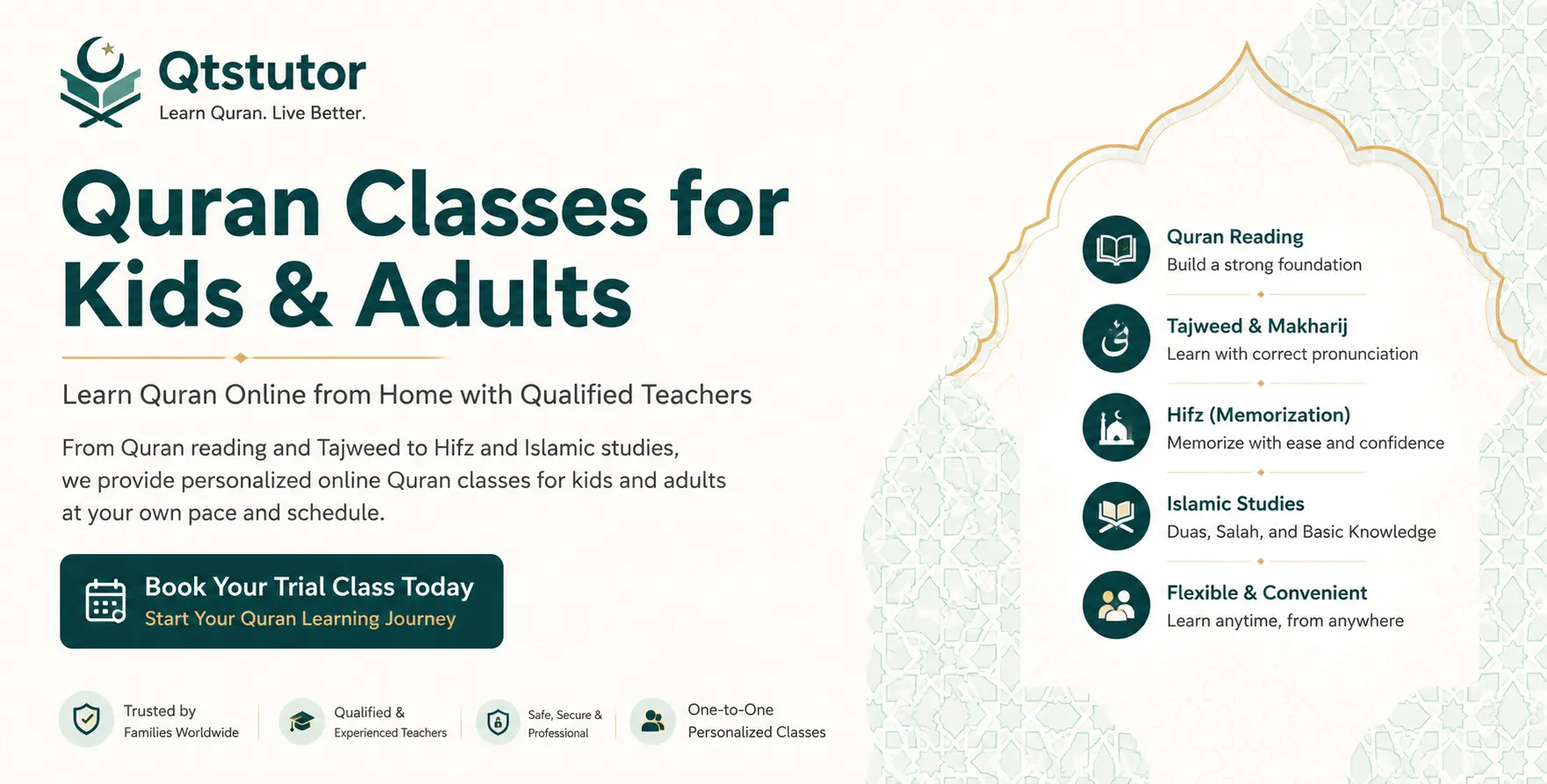
Qtstutor.com provides online Quran learning opportunities for students who want to study from home with structured guidance.
The academy can serve learners with different goals, including Quran reading, Tajweed, memorization, and foundational Islamic learning.
Available learning areas can include:
- Online Quran classes for kids and adults
- Quran reading lessons
- Tajweed classes
- Hifz classes
- Madani Qaida
- Quranic Arabic
- One-to-one online Quran lessons
The objective is to create a learning environment where students can progress gradually and receive guidance according to their level.
For families searching for Quran Education Online, an organized course with clear lesson goals can make it easier to maintain consistency.
Is Online Quran Learning Suitable for Beginners?
Yes. Online learning can be suitable for beginners when lessons are structured around their starting level.
A student who knows nothing about Arabic can begin with letters, pronunciation, and Qaida. Someone who already recognizes Arabic words can move more quickly into reading practice and Tajweed.
The key is not to compare your progress with someone else’s. Every learner starts from a different point.
Beginners should also understand that making mistakes is a normal part of learning. With regular practice and constructive correction, many students gradually become more comfortable with reading.
Tips for Learning the Quran Consistently
Consistency is often more important than studying for long periods only once in a while. The following habits can make learning more manageable:
Set a Realistic Schedule
Choose specific days and times for lessons and revision. A manageable routine is easier to maintain over the long term.
Practice Between Classes
Do not rely entirely on lesson time. Even a short daily review can reinforce what you learned.
Read Aloud
Reading aloud allows you to hear your pronunciation and makes it easier to notice areas that require correction.
Keep Track of Progress
Write down the lessons completed, Tajweed topics studied, and sections that need revision.
Ask Questions
A good teacher should be able to explain difficult concepts in simple language. Ask whenever a rule or pronunciation point is unclear.
Focus on Steady Improvement
You do not need to master everything immediately. Small improvements in reading, pronunciation, vocabulary, and understanding can add up over time.
Frequently Asked Questions About Quran for All
What is Quran for All?
Quran for All is an inclusive approach to Quran education that aims to make learning and understanding accessible to children, adults, beginners, and Muslims worldwide.
Can I learn the Quran online as a beginner?
Yes. Beginners can start with Arabic letters, Madani Qaida, pronunciation, and basic reading before progressing to Tajweed and Quranic recitation.
Can children learn Quran online?
Yes. Online classes can be adapted for children through age-appropriate lessons, repetition, short activities, and regular revision.
How can I learn Quran with Tajweed?
Start with basic Quran reading and pronunciation, then study Tajweed rules under the guidance of a qualified teacher. Regular correction and practice are important.
How long does it take to learn to read the Quran?
The time varies from person to person. It depends on previous knowledge, lesson frequency, practice habits, age, and consistency.
Can adults learn Quran online?
Absolutely. Adults can begin at any level, including from the Arabic alphabet. Flexible schedules can make learning easier alongside work and family responsibilities.
Is online Quran learning effective?
It can be effective when students receive structured lessons, qualified instruction, regular correction, and sufficient practice between classes.
How can I find a qualified Quran teacher online?
Look for relevant Quran and Tajweed knowledge, teaching experience, clear communication, patience, flexible scheduling, and an instructional approach suited to your learning level.
Can I learn Quran translation and meaning online?
Yes. Students can study reliable translations and introductory explanations alongside recitation. More advanced interpretation should be studied through appropriate scholarly resources.
What should I learn first when starting the Quran?
Most complete beginners should start with Arabic letters, pronunciation, and a foundational Qaida before moving into full Quran reading.
How often should I take Quran classes?
The ideal schedule depends on your goals and availability. Regular lessons combined with practice between classes can support steady progress.
Does Qtstutor.com offer online Quran classes?
Qtstutor.com provides online Quran learning services that can include Quran reading, Tajweed, Hifz, Madani Qaida, Quranic Arabic, and lessons for children and adults.
Conclusion: Making Quran Learning Accessible to Everyone
The beauty of Quran education is that learning can begin at any stage of life. A beginner can start with the alphabet, a child can develop strong reading foundations, and an adult can return to study after years away.
With online education, students can access lessons from home, work with a teacher, choose suitable schedules, and develop their skills step by step.
The idea of Quran for All is about making that journey accessible, welcoming, and practical. Whether your goal is to improve recitation, learn Tajweed, memorize selected portions, or better understand the Quran, consistent study can help you move forward.
Explore online Quran learning with Qtstutor.com and take the next step toward reading and understanding the Quran with greater confidence.